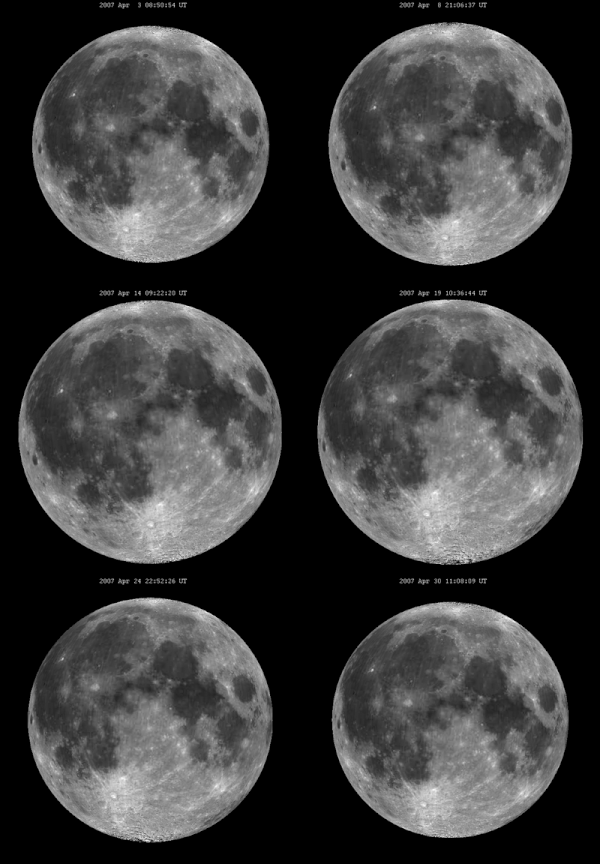
The Moon has been a source of curiosity for people throughout the ages since it has been a constant guide or marker to our night sky. One of the things that makes it so curiously attractive is that, although it is in different phases and travels a coordinated way in the sky, we only witness half of it. Thus, the mechanism of tidal locking explains why only one of the Moon's hemispheres is always toward Earth, whereas the other one, however, stays invisible.

What Is Tidal Locking?
The explanation we see just a single side of the Moon is because of tidal locking.Tidal locking is a process where the same side of the Moon is always turned towards the Earth. Tidal locking occurs when a celestial body's rotational period (the time it takes to complete one rotation on its axis) and its orbital period (the time it takes to complete an orbit around another body) become equal. In the case of the Moon, it takes about 27.3 days to rotate on its axis and the same 27.3 days to orbit the Earth once. Due to the synchronization of the time, the Moon only shows one side to the Earth continuously.
This influence is not at all a peculiar one just to the Earth-Moon system; it's rather a ubiquitous one in the universe. Many of the moons of our solar system, such as Jupiter's and Saturn's ones, are tidally locked to their parent planets. This tidal force is applied by gravity, making the orbit time of satellite (like the moon) be equal to that of the rotational period.
The Mechanics Behind Tidal Locking
In examining the physics of tidal locking, the gravitation between two bodies is the requirement for insight. When the Earth and the Moon, or the Sun and a planet, are close to each other, they apply huge gravitational forces on each other. The Moon's gravitational force on Earth makes the Earth bulge slightly, hence creating a tidal bulge on the Moon's surface. This is not the real change of the Moon's surface but a stretching which leads to the Moon's shape slightly changing.
Through a long time, these tidal forces, which act as a breaking effect, have changed the Moon's rotation. It happened when the Moon was young, it was rotating at a much higher rate than now. Yet the Earth by means of gravitational forces, caused the Moon to develop tidal bulges to grip it thus the Earth, eventually the Moon’s rotation period became the orbital period. To date, the Moon has been locked in tidal orbit and its day-long rotation is also in time with it.
This same effect happens in reverse, with the Moon exerting a gravitational pull on Earth. Earth's rotation is also slowing down, though at a much slower rate, due to tidal friction caused by the Moon. Scientists estimate that eventually, Earth's rotation will slow to the point where it will also be tidally locked with the Moon. However, this process would take billions of years, and long before that, other cosmic events would likely reshape the Earth-Moon system.
Synchronous Rotation and the Far Side of the Moon
The side of the Moon that always faces Earth is known as the "near side," while the contrary half of the globe, which we can never see from Earth, is known as the "far side." Sometimes, people refer to it as the “dark side” of the Moon, though this term is misleading. The two sides of the Moon experience daylight and darkness throughout its 29.5-day lunar cycle. Thus, the two sides of the Moon have days and nights, just as Earth does, but only the near side is visible to us.

On account of present day space investigation, in any case, we've had the option to concentrate on the far side of the Moon. The principal look at the far side came from the Soviet Association's Luna 3 mission in 1959, which caught the main pictures of this puzzling half of the globe. From that point forward, various missions, including NASA's Lunar Observation Orbiter, have planned the whole surface of the Moon in high goal. The furthest side of the Moon has a bigger number of craters and rugged terrain than the near side, which might be because of the absence of "magma oceans" (maria) that are more normal on the near side.
Why Is One Side of the Moon Heavily Cratered?
When you compare images of the near and far sides of the Moon, one observable distinction is how much crater impacts. The far side of the Moon is significantly more intensely cratered than the side confronting Earth.This disparity likely occurred because the near side contains large, flat plains called maria (Latin for "seas"), which are created by ancient volcanic activity. When large asteroids impacted the near side of the Moon, lava flowed across the surface, covering many craters and creating smoother plains.On the far side, volcanic activity was less predominant, so craters amassed more than billions of years without being covered by lava. This distinction in surface highlights has given important data to researchers concentrating on the Moon's geological history and internal composition.
The Role of Lunar Librations
Even though the Moon is tidally locked, careful observers will note that we actually see slightly more than 50% of its surface from Earth. This phenomenon, known as “libration,” is due to the Moon’s orbit around Earth, which is slightly elliptical rather than perfectly circular. As the Moon moves closer to and farther from Earth along this elliptical path, the speed of its orbit varies slightly, causing a slight "wobble." Additionally, the tilt of the Moon’s axis allows us to see over its north and south poles slightly as it orbits.
Librations allow us to see about 59% of the Moon’s total surface over time. However, the remaining 41% of the Moon, located primarily on the far side, is never visible from Earth without the aid of space probes and orbiting satellites.
The Broader Significance of Tidal Locking

The Earth-Moon tidal locking is an important aspect of the stability of Earth’s environment. The Moon's gravitational effect on The planet, essentially seen in tidal movement in our oceans, adds to our planet's relatively stable climate. In the event that the Moon were not tidally locked and on second thought pivoted freely, the elements among Earth and the Moon could contrast essentially, potentially affecting Earth’s climate and the evolution of life.
Additionally, concentrating on tidal locking gives understanding into the elements of other heavenly bodies and planetary frameworks. Understanding how and why moons become tidally locked can help scientists predict the rotational behavior of exoplanets orbiting stars beyond our solar system. Numerous exoplanets are reasonable tidally locked to their parent stars, meaning one side generally faces the star, making outrageous temperature varieties between the two halves of the globe. These temperature distinctions would altogether influence likely potential habitability, atmospheric conditions, and the possibility of life.
Conclusion
The reason we only see one side of the Moon is a result of tidal locking, a process shaped by gravitational forces over billions of years. The synchrony between the Moon's rotation and orbit has profound implications not only for our understanding of the Moon but for the stability of Earth itself. Thanks to tidal locking, the near side of the Moon has remained a familiar sight to humanity across all of recorded history, while the far side remained hidden until the modern era of space exploration.
The Earth-Moon relationship exemplifies the delicate gravitational dance that can occur in space, illustrating how cosmic forces influence the motion and behavior of celestial bodies. As we continue to explore the Moon and beyond, this understanding of tidal locking will help us unravel the mysteries of other moons, planets, and star systems, expanding our knowledge of the universe and our place within it.