
You've Been Lied To.
Well, maybe not lied to, but you've certainly been given an incomplete picture. From the moment we first learn to add apples and oranges, we're taught a rigid, unshakeable rule: if you add a bunch of positive numbers together, the sum just gets bigger and bigger. If the list of numbers goes on forever, the sum either explodes to infinity or settles nicely on a specific number.
This is the bedrock of calculus and analysis. It's clean, it's logical, and for the vast majority of practical purposes, it's correct.
But what if I told you that, in a certain brilliant and bizarre way, the sum of all positive integers is not infinity, but...
-1/12
Yes, you read that correctly:
1 + 2 + 3 + 4 + 5 + … = -1/12
This isn't a trick. It's not a "limit" in the way you learned in school. It's a result of something profound, beautiful, and incredibly modern called Ramanujan Summation. It's a concept that stretches the very definition of "sum" to reveal hidden layers of reality, layers that are absolutely crucial for our most advanced theories in physics.
So, let's dive in. Forget what you know about addition for a moment. We're going on an adventure.
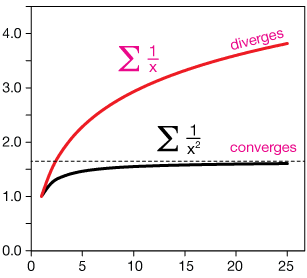
Image: Abstract visualization of infinite series
The Prodigy from Kumbakonam
To understand this idea, you have to understand the man behind it: Srinivasa Ramanujan.
Born in 1887 in South India, Ramanujan was a self-taught mathematical mystic. He worked in near-isolation, deriving complex theorems from a place of pure intuition. He claimed his insights were given to him in dreams by the goddess Namagiri. Given the results, it's hard to argue.
He filled notebooks with thousands of identities and equations, many without proof, arriving at them through a process he couldn't fully explain. His work was so revolutionary that he eventually sent a letter to the renowned British mathematician G.H. Hardy at Cambridge.
"Hardy, initially skeptical, soon realized he was looking at the work of a genius 'of the highest quality.' He brought Ramanujan to Cambridge, and their collaboration became one of the most famous stories in mathematics."
Ramanujan's mind operated on a different plane. He saw connections where others saw chaos. And his method of summation is a perfect example.
Image: Portrait of Srinivasa Ramanujan
A (Slightly) More Technical Glimpse
So how do we get to this magical -1/12? Let's walk through a simplified version of the process, often attributed to Ramanujan. It's not a rigorous proof in the modern sense, but it beautifully illustrates the conceptual leap.
Step 1: Tame the Oscillating Series
Let's define C = 1 - 2 + 3 - 4 + 5 - 6 + ...
Now, what if we add this series to itself, but shift the terms one place to the right?
C = 1 - 2 + 3 - 4 + 5 - 6 + ...
+ C = 1 - 2 + 3 - 4 + 5 - ...
2C = 1 - 1 + 1 - 1 + 1 - 1 + ...
Look at that! We've gotten our old friend, the Grandi's series: S = 1 - 1 + 1 - 1 + ...
So, 2C = S.
Now, what is S? Let's be clever. S = 1 - 1 + 1 - 1 + ... So, what is 1 - S?
1 - S = 1 - (1 - 1 + 1 - 1 + ...) = 1 - 1 + 1 - 1 + 1 - ... which is just S again!
So, 1 - S = S. Solving this simple equation: 1 = 2S, so S = 1/2.
We've now assigned a value of 1/2 to the divergent series 1-1+1-1+...
Therefore, since 2C = S, we have 2C = 1/2, which means C = 1/4.
Boom. We now have a value for our second divergent series: 1 - 2 + 3 - 4 + ... = 1/4.
Step 2: The Main Event
Now, let's define the big one: N = 1 + 2 + 3 + 4 + 5 + 6 + ...
Subtract our friend C from N:
N = 1 + 2 + 3 + 4 + 5 + 6 + ...
- C = 1 - 2 + 3 - 4 + 5 - 6 + ...
N-C = 0 + 4 + 0 + 8 + 0 + 12 + ...
Notice a pattern? We can factor out a 4:
N - C = 4(1 + 2 + 3 + ...)
But look inside that parenthesis! It's our original series N again!
So, N - C = 4N
Now we have a simple equation: N - C = 4N.
Let's solve it: Bring the N's together: -C = 4N - N => -C = 3N.
Therefore, N = -C/3.
But we already found that C = 1/4.
So, N = -(1/4) / 3 = -1/12.
And there it is. 1 + 2 + 3 + 4 + 5 + ... = -1/12.
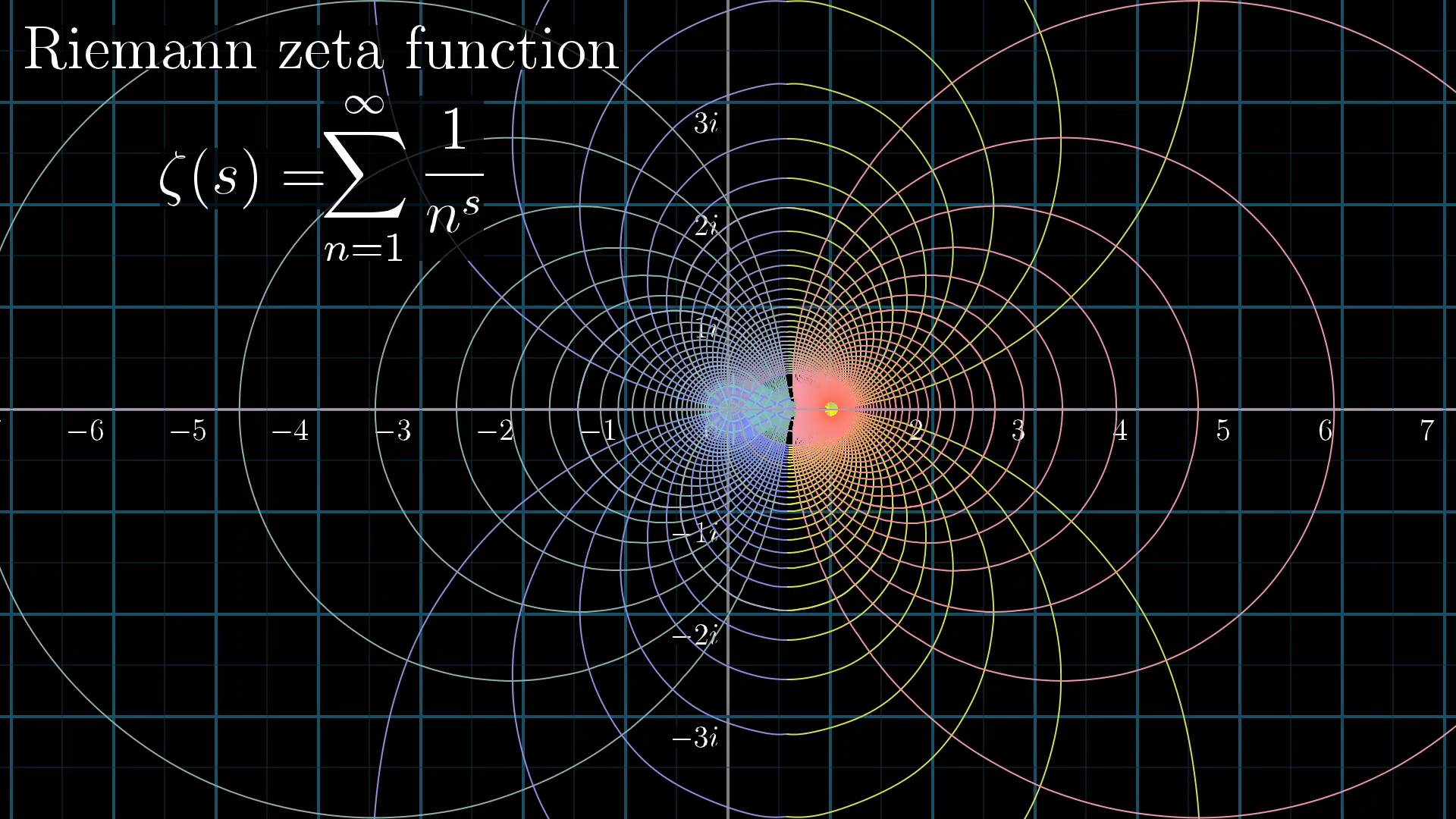
Image: Visualization of the Riemann Zeta Function
Why Should You Care? It's Not Just a Party Trick
This is where the story gets truly modern and mind-blowing. This seemingly absurd result isn't just abstract mathematics. It shows up in the real world, specifically in one of our most successful scientific theories: Quantum Field Theory.
In particular, the Casimir Effect provides a stunning physical manifestation.
Imagine: You have two uncharged, perfectly conducting metal plates placed very close together in a vacuum. According to classical physics, nothing should happen. But in reality, they are pulled towards each other by a faint, measurable force.
Why?
Quantum mechanics tells us that a vacuum isn't empty; it's a seething soup of "virtual particles" constantly flickering in and out of existence. These particles create fluctuating energy fields. However, between the two plates, only certain wavelengths of these fluctuations can fit. Outside the plates, all wavelengths are possible.
This difference in the possible energy states inside and outside the plates creates a pressure difference, pushing the plates together. When physicists go to calculate this energy difference, they encounter an infinite sum that looks suspiciously like 1 + 2 + 3 + 4 + ...
To get a finite, physical, measurable answer, they must regularize this infinity. And the tool they use assigns this divergent series the value of -1/12. The final, precise calculation using this value predicts the Casimir force with incredible accuracy. Experiment confirms it.
The universe itself, at its most fundamental level, is telling us that the Ramanujan sum of 1+2+3+... is -1/12. It is the physically relevant value.
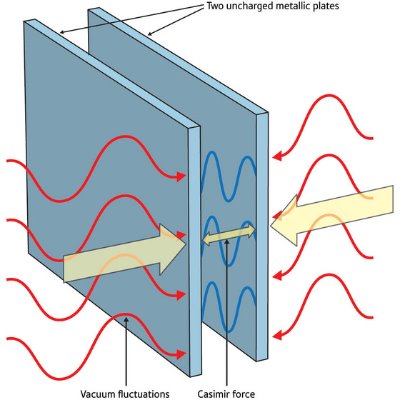
Image: Diagram illustrating the Casimir Effect
The Takeaway: A Broader Truth
The journey of 1+2+3+... = -1/12 is a profound lesson in the evolution of knowledge.
It teaches us that our definitions are not sacred. They are context-dependent tools. The "sum" you learned in school is perfect for balancing your checkbook, but it's inadequate for describing the quantum vacuum.
Ramanujan, with his almost supernatural intuition, saw beyond the rigid rules of his time. He saw a deeper structure where others saw only nonsense. His work reminds us that progress often lies not in finding new answers, but in asking new questions—and, most importantly, in redefining the very meaning of the words we use to ask them.
So the next time you hear someone state a "fact" with absolute certainty, remember the story of the Indian clerk who looked at the sum of all positive integers and saw a negative fraction. Truth, it turns out, is often more flexible, more bizarre, and more beautiful than our everyday tools can ever reveal.