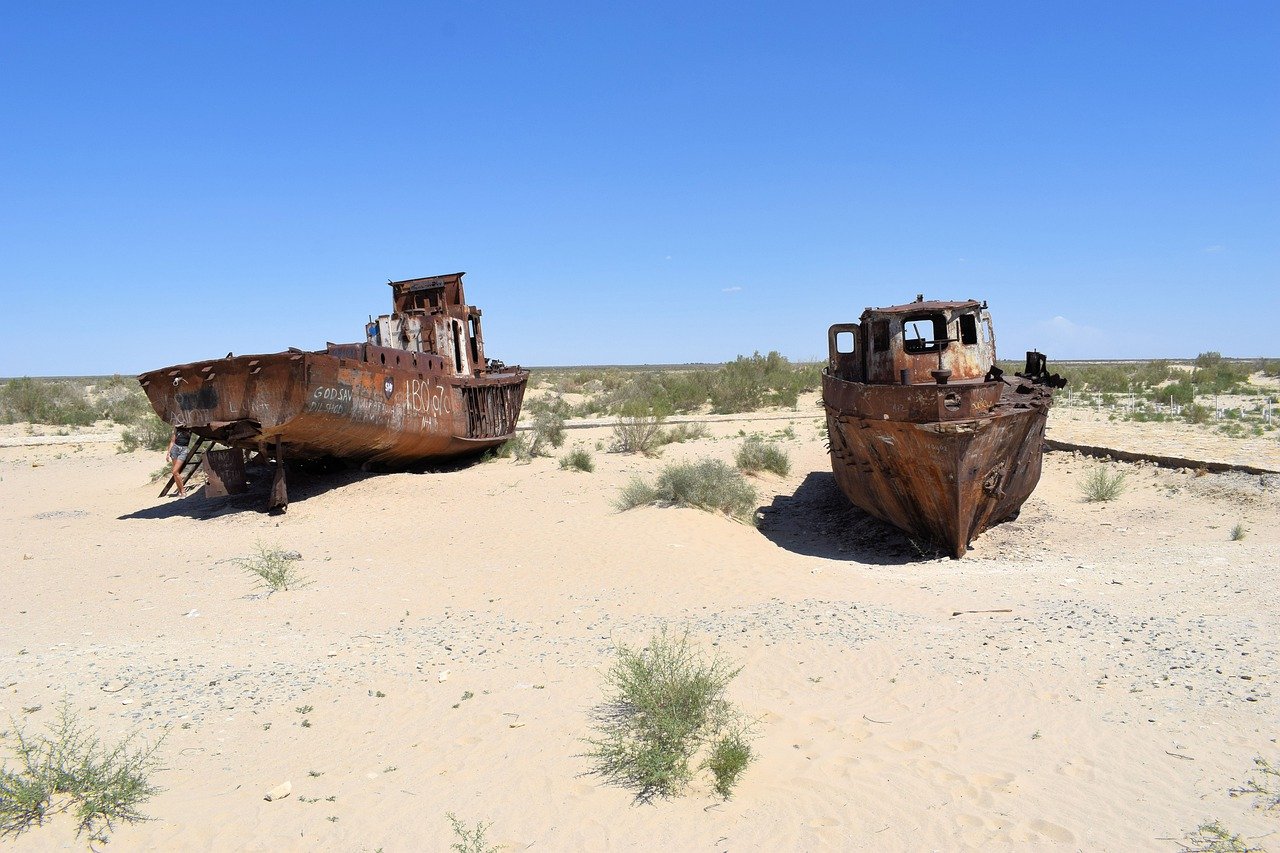
Aral Sea , it is an endorheic lake that lies among Kazakhstan and Uzbekistan. It was the fourth biggest sea on the planet. Prior to the time of 1960's, it was the significant spot for financial exercises for individuals of Karakalpakstan (Uzbekistan) in the south and Aktobe and Kyzylorda Regions (Kazakhstan) in the south. It used to help individuals as it had loads of fishes, the sea sea shore was close, the climatic condition was moderate. The sea was additionally the one of the significant fish providers for then USSR.
Tributaries of Aral Sea
The significant feeders of Aral Sea were 'The Amu Darya' and 'The Syr Darya'.
Amu Darya

The Amu Darya streams in central Asia and Afghanistan. It starts in Pamu mountains in Tajikistan. It is shaped by the combination of two rivers Vakhsh and Panj. Not far beneath the Qonduz , Kofarnihon and Surkhan rivers join Amu Darya. It then, at that point, flows northwest which is the northern line of Afghanistan, Turkmenistan, Uzbekistan and Tajikistan. It follows the courses between the deserts Karakurum and Kyzylkum. Before 1960's, it used to the one of the significant tributaries of The Aral Sea. It is indispensable for the livelihoods of around 43 million population as it gives irrigation to the horticulture. It is additionally significant for hydropower, industries, domestic and drinking purposes.
Syr Darya
The Syr Darya is the river in central Asia flowing through Uzbekistan, Tajikistan and Kazakhstan. It is considered as the longest river in central Asia. It is shaped by the combination of Naryn and Qoradaryo streams in the Fergana valley, which originates from Tian Dhan Mountains in Kyrgyzstan and eastern Uzbekistan. It is then joined by rivers Ohangaron, Chirchiq, Keles and Arys. It finishes the courses in Kyzylkum desert. The greater part of the water of this river are absorbed there. Thus, relatively, the volume of water in Syr Darya is less than the Amu Darya. Before 1960's it was additionally one of the significant tributaries rivers of the Aral Sea. It is additionally imperative for the occupations of individuals living its bowls since it gives irrigation to the cotton and rice plants and is likewise answerable for creating power through different hydropower projects.

The emergency
During 1960's the then USSR government led by Khrouchtchev, chose to water the desert districts around the sea to cotton plants. In this way, they began burrowing channels for irrigation. The progressions of both the waterways to the Aral Sea were totally cut off. It is constantly informed that the nature does what it attempts to do however on the off chance that there stays human interference to the nature and climate, it hits back us. Larger part of the water inlet for the Aral Sea were quickly cut off. Additionally, much measure of the water of both the waterways used to be drenched by the deserts as well. The Sea gets around 20% of its water through the rainfall and for outstanding it utilized be totally subject to those two waterways. At the point when the waterways quit going to the sea, the sea began to evaporate. When of late 90's it was tracked down that the water level was around 20m, with the volume of 210km3 when contrasted with 1060km3 in 1960.

Impacts of contracting
The contracting of the Aral Sea is considered as 'the most noticeably terrible ecological debacle in the modern period'.
Effect on climate
Water level
The water level began to drain quickly on the sea. Albeit, the water level has changed in the previous many years, it has never arrived at the level that was there in the sea before 1960s. The volume of the water in the sea is dictated by different variables: waterway input, rate of evaporation and precipitation and ground water inflow. At the point when the rivers input began declining from 1960s, the rate of evaporation of water and precipitation additionally subsided. However, the ground water inflow was something similar, so water balance began to diminish.

In the main decade after the river water inlet were removed, the water level began to diminish about 21cm each year. Subsequently, the water-level began to diminish by 57cm each year. The lake began to become shallower, because of that the less volume of water needed to confront more solar radiation coming about the expansion in the rate of evaporation. The other factor that increased the rate of evaporation was the stratification. The stratification is the change in water temperature and salinity level around a specific water body. Due to decrease in water level, the level of salt was less on the surface than in the bottom. It resulted in heating of water more than the condition when the salt level is evenly distributed.
Amphibian Eco- System
As the volume of water began to diminish, the amphibian environment began to decrease quickly. The sea used to be the home of various types of endemic fishes. A portion of the fishes were migratory fishes too. Because of development of various dams in the gulf waterways and contracting of the sea has totally impeded those fishes. It additionally used to be an ideal home for some around 250 types of invertebrates. Around 80% of them were fresh water remaining were marine. Later their number began to diminish too due to diminishing in the level of water. Later in the bombed endeavor to build the sea lives, some other amphibian creatures like 'Mullet' were acquainted with the sea. That was additionally capable to diminish the quantity of invertebrates inside the sea.
Environmental Change
Before the sea contracted, it used to be fundamental for the guideline of environment around its locale. It used to soften the Siberian breeze in the colder time of year and used to chill the area in the summer. It has been seen through various information between 1960 to 2000 the average monthly temperature has increased from 2 degree centigrade to 6 degree centigrade during summer and has expanded the normal temperature during winter also resulting hot climate in the region.
Because of expansion in temperature the glaciers around the area have begun to melt quickly. As, the glaciers are melting ceaselessly the climate will turn out to be more averse to encounter the kind of occasional steadiness it once did.

Impact on socio-economic status
When individuals of the district used to procure their vocations by relying on the sea. They used to get the sea-going living beings. The sea shores would be the ports for some, water transports. Streams were conceivable. Individuals were happy. The financial status was acceptable.
As the aftereffect of drying of water, the amphibian organic entities went to the degree of close to eradication. The sea shores retreated miles from the spots that used to be previously. The conditions of the people became such like it was hard to earn the livelihood. Must individuals around the sea relocated to more comfortable regions. The people who remained were tormented by dust storms that contained the harmful buildup of chemical cotton agribusiness and weapons testing nearby. Plus, subsequent to contracting of sea, the salt residue that remained in the dried sea land, caused salt storms resulting serious health issues to the population residing in the area.
In 2005, from the aid of world bank the rebuilding venture of dam started in Kazakhstan by the adage of reestablishing the sea in north Aral Sea. It has worked on the water level in the North Aral Sea. From that point forward, the water level has risen. The amphibian creatures have returned. The satellites pictures given by NASA in 2014 uncovered that the eastern piece of the Aral Sea had totally evaporated resulting a desert, which is currently called as the Aralkum Desert.
I trust with the legitimate administration of water bay, the sea might return alive as it used to be previously.