The Universe is an unfathomably vast expanse that includes everything we know planets, stars,galaxies and even the smallest particles. It is home to trillions of galaxies, each containing billions of stars and planetary systems. Scientists estimate that the Universe is about 13.8 billion years old, constantly expanding and evolving.
The Origin of the Universe
The Big Bang Theory

The most widely accepted explanation for the Universe’s origin is the Big Bang Theory. According to this theory, the Universe began as an extremely hot, dense singularity about 13.8 billion years ago. It then rapidly expanded and cooled, forming the first subatomic particles, atoms, and eventually galaxies.
The Big Bang Theory was first proposed by Georges Lemaître, a Belgian Catholic priest, astronomer, and physicist, in 1927. He described it as the "hypothesis of the primeval atom" or the "cosmic egg." Lemaître theorized that the universe began from a single point, which he called the primeval atom, and has been expanding ever since.
Key Contributions
Georges Lemaître (1927)
- Proposed the idea of an expanding universe, based on Einstein's general theory of relativity.
- Suggested that the universe began as a single "quantum" or "primeval atom."
Edwin Hubble (1929)
- Provided observational evidence for the expansion of the universe by discovering the redshift of galaxies, which became a cornerstone of the Big Bang Theory.
Albert Einstein
- Although initially resistant, his theory of general relativity laid the mathematical foundation for Lemaître’s idea of an expanding universe.
Arno Penzias and Robert Wilson (1965)
- Discovered the Cosmic Microwave Background (CMB) radiation, a key piece of evidence for the Big Bang Theory.
Evidence Supporting the Big Bang
- Cosmic Microwave Background Radiation (CMB): Faint radiation detected across the Universe, considered a remnant of the Big Bang.
- Redshift of Galaxies: Observations show galaxies moving away from us, indicating an expanding Universe.
- Abundance of Elements: Predictions about the proportion of hydrogen and helium in the Universe match observational data.
Hubble’s Study and Hubble’s Law
Edwin Hubble revolutionized cosmology by proving that galaxies are moving away from each other, implying that the Universe is expanding.
Hubble’s Law
Hubble's Law was first proposed by Edwin Hubble in 1929, based on observations of galaxies and their redshifts. He combined his findings with earlier work by Vesto Slipher, who measured the redshift of galaxies, and Georges Lemaître, who proposed the theoretical framework for an expanding universe.
Hubble discovered that the speed at which galaxies recede is proportional to their distance from Earth. It states that the speed with which two galaxies move away from each other is directly proportional to the distance between them.
v α d
or, v=H ⋅ d (where H is proportionality constant and is called as Hubble’s constant)
The value of H is 73.8 kilometers per second per megaparsec (km/s/Mpc)
The Doppler Effect and Light Shifts
What is the Doppler Effect?
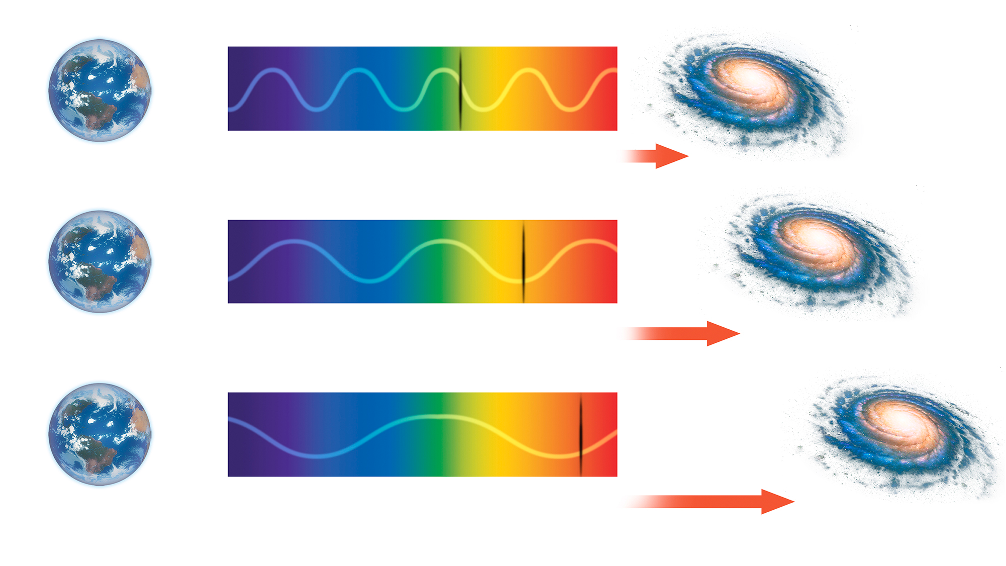
The Doppler Effect refers to the change in frequency or wavelength of waves as the source moves relative to an observer. For light, this effect explains redshift and blueshift.
Redshift vs. Blueshift
Redshift
It is a phenomenon where the wavelength of light or other electromagnetic radiation from an object is stretched, making the light appear redder than it originally was. It occurs when the source of the light is moving away from the observer.
Blueshift
It is the phenomenon where the wavelength of light or other electromagnetic radiation from an object decreases, causing the light to shift toward the blue end of the spectrum. This occurs when the source of the light is moving towards the observer.
These shifts help astronomers determine whether celestial objects are approaching or receding from Earth.
Structure of the Universe
The Universe is a tapestry of galaxies, stars, and interstellar matter. At its largest scale, it consists of:
- Galaxies: They are the massive systems of stars, gas, and dark matter held together by gravity.
- Stars: They are luminous celestial objects made primarily of hydrogen and helium.
- Interstellar Matter: They are gas and dust between stars, the building blocks for new stars and planets.
Additionally, the Cosmic Microwave Background Radiation (CMB) acts as a fingerprint of the early Universe, providing vital clues about its origin and structure.
Four Fundamental Forces of Nature
The Universe is governed by four fundamental forces:
- Gravitational Force: It is responsible for the attraction between masses.
- Electromagnetic Force: It governs interactions between charged particles.
- Strong Nuclear Force: It binds protons and neutrons in the nucleus.
- Weak Nuclear Force: It causes radioactive decay, essential for energy generation in stars.
These forces work together to shape the cosmos.
Gravitational Force and Its Importance
Gravitational force is the weakest yet most influential force in the Universe. It governs the motion of planets, the formation of stars, and the behavior of galaxies. Without gravity, the Universe as we know it would not exist.
Density of the Universe
Mean Density
Mean density refers to the average mass per unit volume in the Universe. It is defined as the total mass of an object divided by its total volume. It provides a measure of how much mass is concentrated in a given volume.
Critical Density
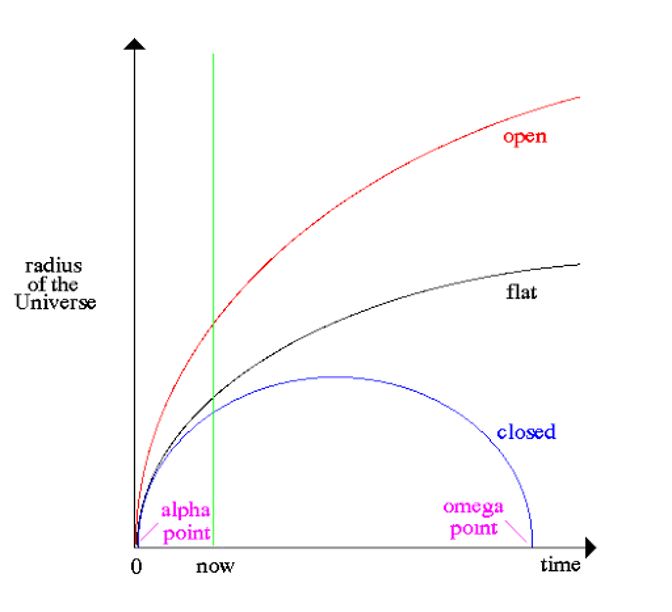
Critical density determines whether the Universe will expand forever or eventually collapse. It is a key concept in cosmology that refers to the density of matter and energy required for the universe to have a flat geometry. It represents the dividing line between different possible fates of the universe, such as eternal expansion, eventual collapse, or a perfectly balanced state. If the actual density is:
- Higher than critical density: The Universe will eventually contract (Closed Universe).
- Equal to critical density: The Universe will stop expanding (Flat Universe).
- Lower than critical density: The Universe will expand forever (Open Universe).
Models of the Universe
Open Universe
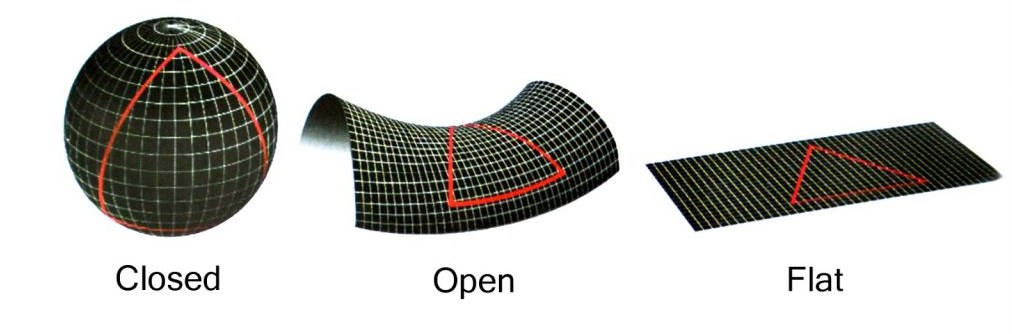
An open universe is a cosmological model where the universe has a geometry of negative curvature (hyperbolic space) and will expand forever. In this scenario, the density of the universe is less than the critical density, meaning there is insufficient gravitational pull to halt the expansion.
In an open universe, the galaxies will continue to move apart, and over time, stars will burn out, galaxies will drift apart, and the universe will cool down, leading to a scenario known as the "Heat Death" or the "Big Freeze."
Geometry:
The universe has a hyperbolic or "saddle-shaped" geometry. Parallel lines eventually diverge, and the angles of a triangle add up to less than 180°.
Closed Universe
A closed universe is a cosmological model where the universe has a spherical geometry (positive curvature) and sufficient matter and energy density to eventually halt its expansion and begin contracting. In this model, the density of the universe is greater than the critical density.
The universe will not expand forever. After reaching its maximum size, it will begin to contract, eventually collapsing into a singularity (the reverse of the Big Bang).
Geometry:
The universe has a spherical shape. Parallel lines converge, and the angles of a triangle add up to more than 180°.
Flat Universe
A flat universe is a cosmological model where the universe has a Euclidean geometry (zero curvature), and its total density equals the critical density. In this model, the universe expands forever, but the rate of expansion slows asymptotically over time.It balances between expansion and contraction, neither collapsing nor endlessly expanding.
Note: A flat universe implies that the total density of the universe is exactly equal to the critical density needed to halt its expansion after an infinite amount of time. If the density is lower than the critical density, the universe would be open and expand forever, whereas if it is higher, the universe would be closed and eventually collapse.
Key Concepts of Cosmology
Cosmology, the study of the Universe's origin, structure, and evolution, introduces fascinating ideas. Two primary concepts are:
Expanding Universe
The Universe has been expanding since the Big Bang. Galaxies are moving away from each other, creating more space over time. This discovery revolutionized our understanding of the cosmos.
Dark Matter and Dark Energy
- Dark Matter: Invisible matter that doesn’t emit or absorb light but exerts gravitational influence on galaxies.
- Dark Energy: A mysterious force responsible for the Universe's accelerated expansion. Together, they constitute about 95% of the Universe’s total mass-energy content.
The Future of the Universe
The fate of the Universe depends on its density and the dominance of dark energy. Let’s explore three possible outcomes:
1. Heat Death (Open Universe)
If the Universe continues expanding indefinitely, galaxies will drift apart, stars will burn out, and temperatures will drop. This scenario predicts a "cold and dark" future.
2. Big Rip (Accelerated Expansion)
If dark energy’s influence increases, the Universe could tear itself apart—stars, planets, and even atoms—leading to the "Big Rip."
3. Big Crunch (Closed Universe)
If the Universe’s density surpasses the critical value, gravity will reverse the expansion, causing the Universe to collapse into a singularity, leading to a "Big Crunch."
Tools for Studying the Universe
Telescopes and Satellites
Telescopes like the Hubble Space Telescope allow us to peer deep into space, capturing light from billions of years ago. Satellites collect invaluable data, free from Earth’s atmospheric interference.
Space Missions
Programs like NASA’s James Webb Space Telescope and ESA’s Gaia mission provide new insights into stars, galaxies, and the Universe’s structure.
Observatories
Earth-based observatories equipped with radio, optical, and infrared technologies continue to contribute to cosmology.
Relation Between the Universe and Everyday Life
Impact on Earth
Phenomena like solar flares, asteroid impacts, and cosmic radiation directly influence our planet. For instance, studying the Sun helps predict solar storms that can disrupt communication systems.
Importance of Space Exploration
Exploring space inspires innovation and fosters international collaboration. Technologies developed for space, such as water filtration systems and medical imaging devices, benefit everyday life on Earth.
Conclusion
The Universe is a vast and mysterious entity that continues to amaze scientists and spark curiosity. From its origin in the Big Bang to its potential future scenarios, understanding the Universe requires unraveling complex phenomena like the Doppler Effect, fundamental forces, and cosmic models. Studying the Universe not only satisfies our curiosity but also advances technology, inspires humanity, and provides practical solutions for Earth’s challenges.
FAQs
1. What is the Big Bang Theory in simple terms?
The Big Bang Theory explains the Universe's beginning as a hot, dense point that expanded and cooled, forming everything we see today.
2. Why is Hubble’s Law important?
Hubble’s Law shows that the Universe is expanding, which supports the Big Bang Theory and helps estimate the Universe’s age.
3. What is the difference between redshift and blueshift?
Redshift occurs when objects move away, stretching light to longer wavelengths. Blueshift happens when objects move closer, compressing light to shorter wavelengths.
4. How do the four fundamental forces shape the Universe?
These forces govern the interactions between matter and energy, influencing everything from galaxy formation to atomic stability.
5. What is the critical density of the Universe?
Critical density is the threshold that determines whether the Universe will expand forever, remain stable, or collapse back into a singularity.





0 Comments