
1. Force
Force is a physical cause that changes or tends to change the state of an object. It can change the speed, direction, shape, or size of an object.
SI Unit: Newton (N)
Formula:
Force = Mass × Acceleration
F = ma
Types of Force
- Contact Force (e.g., frictional force, tension)
- Non-contact Force (e.g., gravitational force, magnetic force)
2. Balanced and Unbalanced Force
Balanced Force: When two or more forces acting on a body cancel each other, and there is no change in motion.
Example: A book lying on a table.
Unbalanced Force: When forces acting on a body are not equal, resulting in a change in motion or direction.
Example: Kicking a football.
3. Motion and Velocity
Motion: A body is said to be in motion if it changes its position with respect to a reference point.
Velocity: The rate of change of displacement. It includes direction.
Velocity = Displacement / Time
- Uniform Velocity: Equal displacement in equal time intervals.
- Non-uniform Velocity: Unequal displacement in equal time intervals.
4. Acceleration and Retardation
Acceleration (a): Rate of change of velocity.
a = (v - u) / t
where,
u = initial velocity,
v = final velocity,
t = time
Retardation: Negative acceleration (velocity decreases with time).
5. Graphical Representation of Linear Motion
a. Displacement-Time Graph
- Straight Line with Positive Slope: Uniform motion
- Curve: Non-uniform motion
- Horizontal Line: Body is at rest
b. Velocity-Time Graph
- Horizontal Line: Uniform velocity
- Sloped Line: Accelerated motion
- Area under graph: Displacement
- Slope of graph: Acceleration
1. Displacement-Time (s-t) Graphs
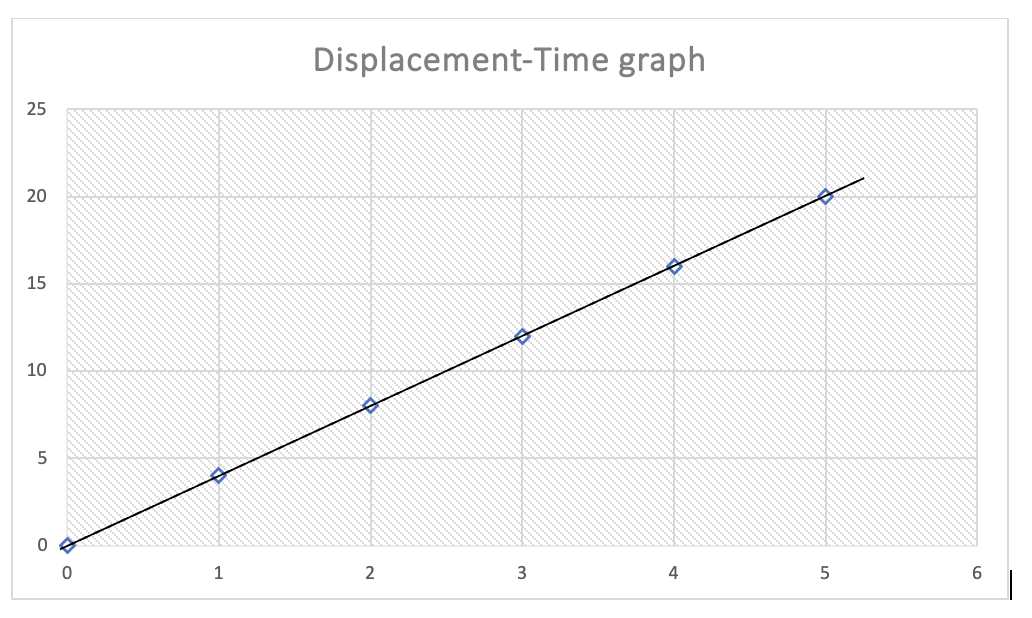
(a) Uniform Velocity
- Graph: Straight line with a constant slope (positive or negative).
- Interpretation: Slope = Velocity (v=Δs/Δt). Steeper slope = Higher velocity.
Example: A car moves 20 m in 5 s at constant speed. Velocity (v) = 20 m/5 s = 4 m/s.
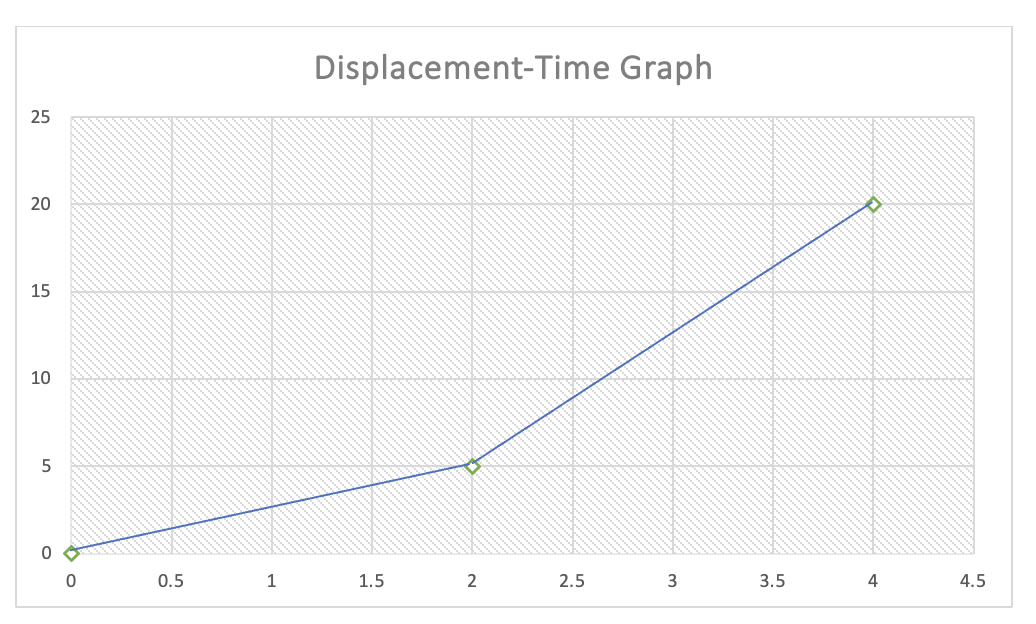
(b) Non-Uniform Velocity (Accelerated Motion)
- Graph: Curved line (parabola for constant acceleration).
- Interpretation: Changing slope = Changing velocity (acceleration).
Example: A car starts from rest and accelerates, covering: 0 m at 0 s, 5 m at 2 s, 20 m at 4 s
2. Velocity-Time (v-t) Graphs
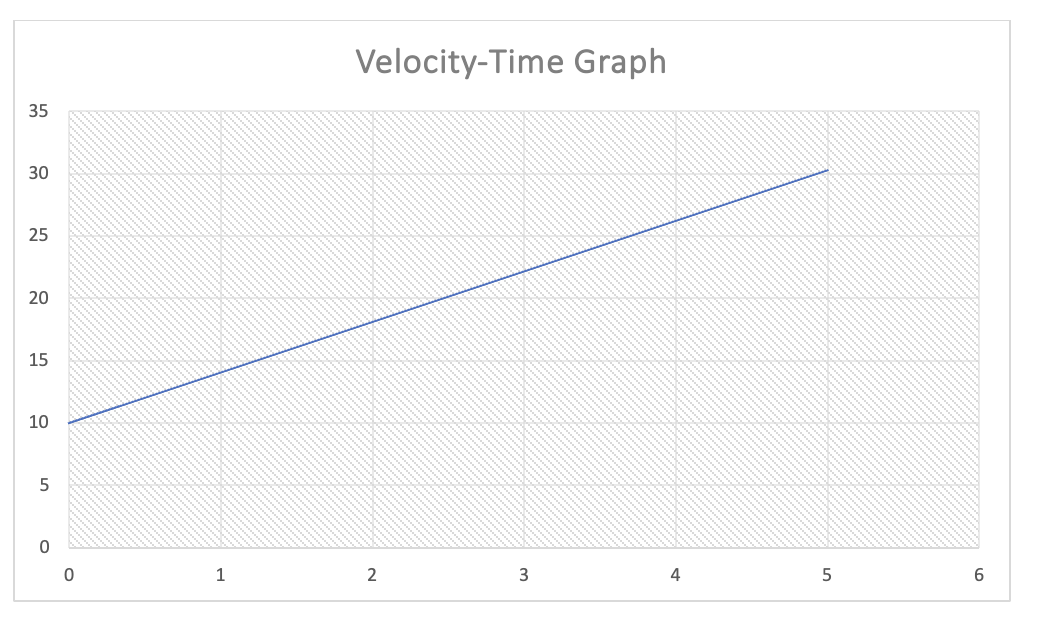
(a) Uniform Acceleration
- Graph: Straight line with positive slope.
- Interpretation: Slope = Acceleration (a=Δv/Δt). Area under graph = Displacement.
Example: A car accelerates from 10 m/s to 30 m/s in 5 s. Acceleration (a) = (30−10)/5 = 4 m/s².
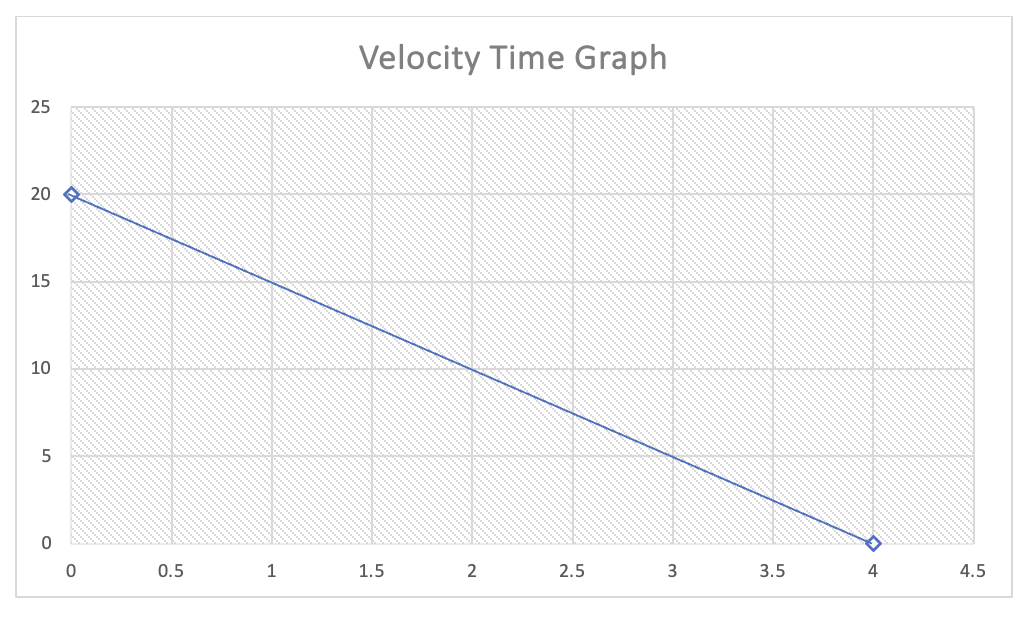
(b) Uniform Retardation (Deceleration)
- Graph: Straight line with negative slope.
- Interpretation: Slope = Negative acceleration (slowing down).
Example: A car slows from 20 m/s to 0 m/s in 4 s. Retardation = (0−20)/4 = −5 m/s².
(c) Constant Velocity (Zero Acceleration)
- Graph: Horizontal line (slope = 0).
- Interpretation: Velocity remains unchanged (no acceleration).
Example: A car moves at 15 m/s for 6 seconds.

Key Takeaways:
Displacement-Time Graph:
- Slope = Velocity.
- Straight line = Uniform velocity.
- Curved line = Acceleration.
Velocity-Time Graph:
- Slope = Acceleration.
- Area under graph = Displacement.
Practice: Sketch a v-t graph for a car:
- Accelerates from 0 to 10 m/s in 2 s.
- Moves at 10 m/s for 3 s.
- Decelerates to 0 m/s in 1 s.
6. Equations of Motion
v = u + at
s = {(u + v) × t} / 2
s = ut + ½ at²
v² = u² + 2as
Where:
u = initial velocity,
v = final velocity,
s = displacement,
a = acceleration,
t = time
Derive v = u + at
Given:
- v = final velocity (in m/s)
- u = initial velocity (in m/s)
- a = constant acceleration (in m/s²)
- t = time (in seconds)
Acceleration (a) is the rate of change of velocity with time:
a = Change in velocity / Time taken
or, a = (v − u) / t
or, at = v – u
or, v = u + at Derived
Derive s = {(u + v) × t} / 2
Given
- s = displacement (in meters)
- u = initial velocity (in m/s)
- v = final velocity (in m/s)
- t = time (in seconds)
Concept of Average Velocity
For motion with constant acceleration, the average velocity is the arithmetic mean of initial and final velocities:
Average Velocity = (u + v) / 2
Relationship Between Displacement, Average Velocity, and Time
Displacement (s) is given by:
Displacement = Average Velocity × Time
Substitute the average velocity:
s = (u + v) / 2 × t
Derived
Derive s = ut + ½ at²
Given:
- v = final velocity (in m/s)
- u = initial velocity (in m/s)
- a = constant acceleration (in m/s²)
- t = time (in seconds)
- s = displacement (in meters)
Using Average Velocity
Average velocity for constant acceleration:
v = (u + v) / 2
or, v = {u + (u + at)} / 2
or, v = (2u + at) / 2
Displacement = Average velocity × time:
s = (2u + at) / 2 × t
or, s = 2ut/2 + at²/2
or, s = ut + ½ at²
Derived
7. Inertia
Inertia is the property of a body to resist changes in its state of rest or uniform motion.
Types of Inertia
Inertia of Rest: A body at rest remains at rest unless acted upon.
Examples:
Sudden Braking of a Vehicle
Scenario: When a moving car stops abruptly.
Observation: Passengers lurch forward.
Why? Their bodies tend to stay in the original state of motion (inertia of rest relative to the car's sudden stop).
Pulling a Tablecloth Trick
Scenario: A tablecloth is yanked quickly from under dishes.
Observation: Dishes stay in place (may wobble but don't move with the cloth).
Why? The dishes resist change due to inertia of rest.
Inertia of Motion: A moving object continues in motion unless stopped.
Examples
Passengers Jerking Forward When a Car Stops
Scenario: A moving car brakes suddenly.
Observation: Passengers lurch forward.
Why? Their bodies resist the change (keep moving at the car's original speed due to inertia of motion).
Athletes Running Before a Long Jump
Scenario: A sprinter takes a run-up before jumping.
Observation: The jumper covers more distance.
Why? The forward motion continues even after the leap (inertia helps maintain horizontal velocity).
8. Newton's Laws of Motion
First Law (Law of Inertia)
A body remains at rest or in uniform motion in the straight line unless acted upon by an external force.
Second Law (Law of Acceleration)
The force acting on a body is equal to the product of its mass and acceleration.
F = ma
Let a body of mass (m) has moved from a point to another point. Let its acceleration be 'a'.
Acceleration of the body is:
- Directly proportional to force applied.
- Inversely proportional to mass of the body.
From above equations, we get
a ∝ f/m
or, f ∝ ma
or, f = kma (where k is proportionality constant)
If 1 N force is applied to the body of mass 1 kg accelerating 1 m/s², at that time value of k is also 1. Putting the value of k in equation 3, we get
f = ma
Third Law (Action and Reaction)
For every action, there is an equal and opposite reaction.
Examples:
Walking or Running
Action: Your foot pushes backward on the ground.
Reaction: The ground pushes forward on your foot, making you move.
Why? Without this reaction force, you couldn't walk!
Rocket Launch
Action: Rocket engines expel hot gas downward.
Reaction: The gas pushes the rocket upward (thrust force).
9. Elasticity and Plasticity
Elasticity: The ability of an object to return to its original shape after the removal of deforming force.
Example: Rubber band
Plasticity: The inability of an object to return to its original shape after deformation.
Example: Clay
| Feature | Elasticity | Plasticity |
|---|---|---|
| Reversibility | It is reversible | It is irreversible |
| Energy | It stores energy | It dissipates energy |
| Material Types | Rubber, steel (below yield point) | Clay, ductile metals |
| Deformation | It is temporary | It is permanent |
10. Numerical Problems (Examples)
Q1. A car accelerates from 5 m/s to 20 m/s in 3 seconds. Find the acceleration.
Solution:
Given
Initial velocity (u) = 5 m/s
Final velocity (v) = 20 m/s
Time taken (t) = 3 seconds
Acceleration (a) = ?
We have,
a = (v - u) / t
or, a = (20 - 5) / 3
or, a = 5 m/s².
Hence, the acceleration of the car is 5 m/s².
Q2. A bus moving at 30 m/s stops in 10 seconds. What is the retardation?
Solution:
Initial velocity (u) = 30 m/s
Final velocity (v) = 0 m/s
Time taken (t) = 10 seconds
retardaion (-a) = ?
We have,
a = (v - u) / t
or, a = (0 - 30) / 10
or, a = -3 m/s².
Hence, the retardation of the car is 3 m/s².
Q3. A body is accelerated from rest at 2 m/s² for 5 seconds. Find the distance covered.
Solution:
Initial velocity (u) = 0 m/s
Time taken (t) = 5 seconds
Acceleration (a) = 2 m/s²
distance (s) = ?
We have,
s = ut +1/2at2
or, s = 0 x 5 + ½ 2 x 25
or, s = 25 m.
Hence, the distance covered by body is 25 m.
Q4. A car moving at 15 m/s brakes and decelerates at 3m/s². How long does it take to stop? How far does it travel while stopping?
Solution:
Initial velocity (u) = 15 m/s
Final velocity (v) = 0 m/s
Acceleration (a) = -3 m/s²
time taken (t) = ?
distance (s) = ?
We have,
v = u + at
or, t = (v-u)/a
or, t = (0-15)/-3
or, t = 5 seconds
Again
s = ut + ½ at2
or, s = 15 x 5 + ½ (-3) x 25
or, s = 75 - 37.5
or, s = 37.5m
Hence, the distance covered by the car is 37.5m and time taken is 5 seconds.





0 Comments