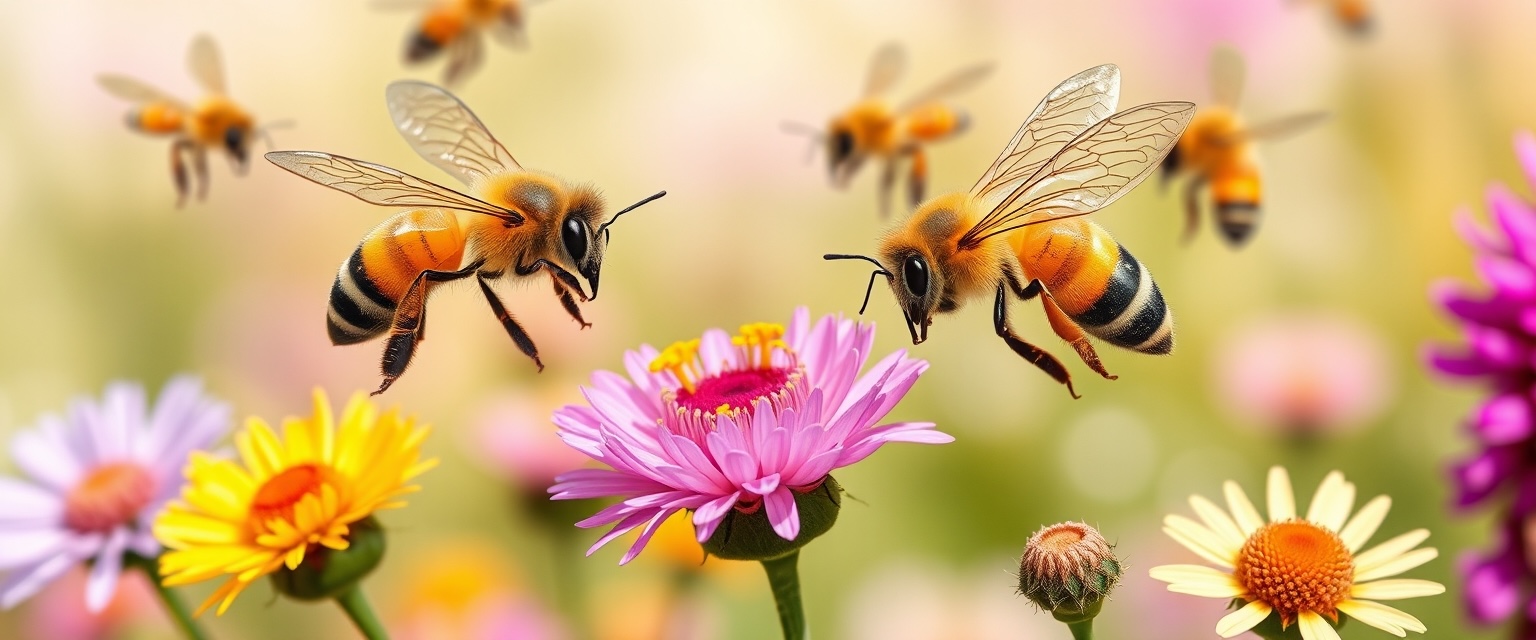
Life in a Hive
A honeybee hive usually has between 20 000 and 80 000 bees living together in a colony. A colony is made up of one queen bee and several hundred drones (males), with female worker bees making up the balance. All the bees share one goal: survival of the colony.
What is nuptial flight?
This is the flight of the bees in which mating takes place between many drone bees and the queen bee. It is usually a prelude to the forming of a new colony.
What is swarming?
Swarming is the process by which a new honey bee colony is formed when the queen bee leaves the colony with a large group of worker bees. In the prime swarm, about 60% of the worker bees leave the original hive location with the old queen.
What is polyandry?
A queen bee often mates with many drones. This mating behavior is known as polyandry.
What is the advantage of polyandry in a bee colony?
Polyandry increases genetic diversity within a colony and thereby improves colony fitness and survival.
Lifecycle of honeybee
The lifecycle of honeybee is perennial. Each colony contains three adult castes: egg-laying queen, sperm-producing drones and non-reproductive worker bees. It completes in four phases.
- Egg
- Larva
- Pupa
- Adult
1. Egg
- The queen bee is only the fertile bee inside the colony.
- She is able to lay eggs with or without fertilization.
- The unfertilized eggs hatch into drones (Male bees). This process is called as parthenogenesis.
- The fertilized eggs hatch into worker bees or the future queen bee (Female bees)

Queen bee lays single egg in each hexagonal structures inside a hive.
- Worker bees look after the eggs.
- The queen bee can lay about 2,000 eggs in a single day.
- It takes about a second to lay a single egg for the queen bee.
- The queen bee has to lay large number of fertilized eggs as they get converted into female worker bees, which are required in large number to maintain the hive.
- As the queen bee ages, her sperm stores decrease and she will produce fewer eggs. The pattern of the eggs within each cell begins to appear less orderly.
- Development from egg to emerging bees varies among queen, workers and drones.
- The queen bee emerges out of an egg in 15-16 days.
- The worker bees emerge out of eggs in 21 days.
- The drone bees emerge out of eggs in 24 days.
2. Larva
- When an egg hatches, it becomes a larva.
- The bee larva (Plural larvae) is a legless and featureless white grub.
- It is specialized to eat and never leaves the individual wax cell.
- They grow in a rapid rate in a five-step development called as metamorphosis.
- It can increase its body size upto 1500 times the original size.
- The larvae are visited 10,000 or so times during their development by adult nurse bees (worker bees) for inspection, feeding and eventually capping of the cells.
- Worker bees bring food and place it in the cells.
- They do not directly feed the larva.
- All bee larvae receive royal jelly after the egg hatches.
- Royal jelly is a protein rich food made in the glands of worker bees and is placed in cells just before the egg hatches.
- After 2.5 to 3 days the larvae of drones and workers are given bee breads (a mixture of pollen and nectar).
- The larva of queen bee is fed on royal jelly.
- The last larval stage, sometimes termed as prepupa, engorges on extra food before the cell is sealed with wax capping.
- The pupal development stages for drones is 6.5 days, workers 6 days and queen 5.5 days.
- If the temperature of the hive decreases, development of larva into pupa takes longer time.
- In addition to containment in a capped cell, the last larval stage also spins a thin silk cocoon within each cell to enclose the pupa.
3. Pupa
- The larva develops into a pupa.
- In addition to containment in a capped cell, the last larval stage also spins a thin silk cocoon within each cell to enclose the pupa.
- The transformations now taking place are hidden from sight under the wax cappings. But if you could, you’d see that this little creature is beginning to take on the familiar features of an adult bee.
- The eyes, legs, and wings take shape.
- Coloration begins with the eyes: first pink, then purple, then black.
- Finally, the fine hairs that cover the bee’s body develop.
- After seven to fourteen days in this stage, depending on the type of bee, the now adult bee chews its way out of the cell. This stage is shorter for the queen, longer for the worker bees and longest for the drones.
4. Adult
Drones
- Drones are male bees and their sole purpose is to mate with the queen: they don't work, don't make honey and can't sting. Since a queen only needs to mate once, most of the drones won't even get the chance to fulfil their role. But worker bees keep them around, just in case a new queen needs mating.
- Drones usually live for about eight weeks and, in that time, have all their needs met by worker bees. In the fall, the worker bees kick the drones out of the hive because keeping them through the winter demands too much work and food.
- You can recognize drones because they are stouter and a little bit longer than worker bees. Their eyes are twice the size of worker bees' eyes because a drone needs good eyesight when he follows the queen high up in the air to mate.
Queen Bee
- Each honeybee colony usually has only one fertile female, the queen and she lays all the eggs in the hive. In the spring, when the colony is growing at its fastest pace, a productive queen can lay up to 2 000 eggs per day. She spends most of her life in the brood chamber of the hive and depends on the worker bees to feed her and dispose of her waste.
- When worker bees decide that a new queen is needed (because, for example, her egg production is dwindling), they feed a new larva on royal jelly alone. As a result, it develops into a sexually mature female bee. She is fed only royal jelly for the rest of her life, which can be up to four years.
- You can recognize the queen by her longer and larger abdomen, although beekeepers often mark her with a permanent pen or a daub of paint so she's easier to identify. Beekeepers need to make sure the queen stays healthy and continues to lay eggs so that the colony survives.

Worker Bee
- Worker bees are female but are not capable of reproducing. They do all the work in the hive, and they control most of what goes on inside. Their jobs include housekeeping, feeding the queen, drones and larvae, collecting the pollen and nectar, and making the wax. Because they work so hard, during the busy season worker bees live for only about six weeks.
- Worker bees are shorter and more slender than drones and the queen, and their back legs have special baskets to help them collect pollen. Like the queen, they also have stingers, but they can only sting mammals once and then they die. They can, however, sting other insects over and over again to protect the hive.

Functions of worker bees
Making Honey
Making honey is an important task for worker bees. They feed it to the developing larvae and also need it as a food source over the winter. The work involved in gathering nectar from flowers and transforming it into honey back in the hive requires that all the worker bees in a colony work together.
The honey made by bees is, of course, also enjoyed by people, as well as by other animals and insects.
Fanning
At some point, as a means of transforming nectar (which is 70 percent water) into honey (which is 17 percent water), worker bees fan their wings at top speed. As the air circulates, the moisture evaporates.
Wax Making
At a certain age, glands on the underside of worker bees' bellies begin to produce wax flakes. They use this wax to build new cells and to cap the ones storing ripened honey. Wax making takes a lot of energy. Bees need to eat 8 kg of honey to produce just 1 kg of beeswax.
Nectar Transfer
At some point, the young worker bee is responsible for receiving the nectar from a foraging bee returning to the hive, and putting it into a cell. She also adds an enzyme to it, which helps ripen the honey.
If there are not enough worker bees on hand to take in the nectar from foraging bees, they will perform a special dance, called the "tremble dance," to encourage other worker bees to help out with this job. Bees use different dances to communicate with each other.
Foraging
At midlife, worker bees begin to go out of the hive to collect nectar, a sweet liquid from flowering plants such as fruit trees, for the colony. They cover a radius of about 4 km from the hive and visit 4 410 000 flowers to make 1 kg of honey. A single worker bee makes just 0.8 g (1/10 of a teaspoon) of honey over a lifetime.
Foraging is a difficult and dangerous job for worker bees and, eventually, their bodies wear out. In the open fields, they face huge risks, such as getting chilled or even being eaten by a bird. They work as long as they can, but most worker bees die while out foraging.
Bee Dance
Since honeybees can't talk, they perform special dances as a means of communication. They use dances to relay different messages, from the need to swarm, to the direction of and distance to a source of food.
Field bees use the "waggle dance" in particular. When they find a great source of nectar, they perform the dance back at the hive to tell other bees where to find the flowers. The dance shows the direction of the flowers relative to the sun, and the bees automatically adjust the dance according to the changing position of the sun in the sky. The speed of the dance indicates how far the nectar is from the hive.
Importance of honey
A good source of antioxidants
Raw honey contains an array of plant chemicals that act as antioxidants. Some types of honey have as many antioxidants as fruits and vegetables. Antioxidants help to protect your body from cell damage due to free radicals.
Free radicals contribute to the aging process and may also contribute to the development of chronic diseases such as cancer and heart disease. Research shows that antioxidant compounds in honey called polyphenols may play a role in preventing heart disease.
Antibacterial and antifungal properties
Research has shown that raw honey can kill unwanted bacteria and fungus. It naturally contains hydrogen peroxide, an antiseptic. Its effectiveness as an antibacterial or antifungal varies depending on the honey, but it’s clearly more than a folk remedy for these kinds of infections.
Heal wounds
Manuka honey is used in medical settings to treat wounds because it’s been found to be an effective germ killer and also aids in tissue regeneration.
Studies show that Manuka honey can boost healing time and reduce infection. Keep in mind that the honey used in hospital settings is medical grade, meaning it’s inspected and sterile. It’s not a good idea to treat cuts with honey you buy from a store.
Phytonutrient powerhouse
Phytonutrients are compounds found in plants that help protect the plant from harm. For example, some keep insects away or shield the plant from ultraviolet radiation.
The phytonutrients in honey are responsible for its antioxidant properties, as well as its antibacterial and antifungal power. They’re also thought to be the reason raw honey has shown immune-boosting and anticancer benefits. Heavy processing destroys these valuable nutrients.
Help for digestive issues
Phytonutrients are compounds found in plants that help protect the plant from harm. For example, some keep insects away or shield the plant from ultraviolet radiation.
The phytonutrients in honey are responsible for its antioxidant properties, as well as its antibacterial and antifungal power. They’re also thought to be the reason raw honey has shown immune-boosting and anticancer benefits. Heavy processing destroys these valuable nutrients.Honey is sometimes used to treat digestive issues such as diarrhea, though there isn’t much research to show that it works. It’s proven to be effective as a treatment for Helicobacter pylori (H. pylori) bacteria, though, a common cause of stomach ulcers.
It’s also a potent prebiotic, meaning it nourishes the good bacteria that live in the intestines, which are crucial not only for digestion but overall health.
Soothe a sore throat
Have a cold? Try a spoonful of honey. Honey is an old sore throat remedy.
Add it to hot tea with lemon when a cold virus hits you.
It also works as a cough suppressant. Research has suggested that honey is as effective as dextromethorphan, a common ingredient in over-the-counter cough medication. Just take one or two teaspoonfuls, straight.
Are there any risks?
In addition to beneficial prebiotics and nutrients, raw honey can also carry harmful bacteria such as Clostridium botulinum. This is particularly dangerous for babies. Raw honey should never be given to an infant less than a year old. Symptoms of botulism poisoning in infants may include:
• constipation
• slow breathing
• sagging eyelids
• absence of gagging
• loss of head control
• paralysis that spreads downward
• poor feeding
• lethargy
• weak cry
In adults, symptoms can include an initial short period of diarrhea and vomiting, followed by constipation and more severe symptoms, such as blurred vision and muscle weakness. See a doctor if you experience any of these symptoms after eating raw honey.
The importance of bees Food security
In order to be able to feed the world’s growing population, we need ever more food, which must be diverse, balanced and of good quality to ensure the progress and well-being of humankind.
Bees are renowned for their role in providing high-quality food (honey, royal jelly and pollen) and other products used in healthcare and other sectors (beeswax, propolis, honey bee venom). But the work of bees entails much more!
The greatest contribution of bees and other pollinators is the pollination of nearly three quarters of the plants that produce 90% of the world’s food. A third of the world’s food production depends on bees, i.e. every third spoonful of food depends on pollination.
Sustainable farming and income
Over the past 50 years, the amount of crops that depend on pollinators (i.e. fruit, vegetables, seeds, nuts and oilseeds) has tripled. Bees play an important role in relation to the scope of agricultural production. Effective pollination increases the amount of agricultural produce, improves their quality and enhances plants’ resistance to pests.
Cultivated plants that depend on pollination are an important source of income to farmers, especially smaller farmers and family-owned farms in developing countries. They provide jobs and income to millions of people. According to the estimates of an international study conducted in 2016 by the Intergovernmental Science-Policy Platform on Biodiversity and Ecosystem Services, the annual global production of food that depends directly on pollination was worth between $235 and $577 billion. Furthermore, agricultural plants that require pollination are an important source of jobs and income for farmers, especially small farmers and family-owned farms in developing countries.
Biodiversity and environmental protection
Bees are vital for the preservation of ecological balance and biodiversity in nature. They provide one of the most recognizable ecosystem services, i.e. pollination, which is what makes food production possible. By doing so, they protect and maintain ecosystems as well as animal and plant species, and contribute to genetic and biotic diversity.
Bees also act as indicators of the state of the environment. Their presence, absence or quantity tells us when something is happening with the environment and that appropriate action is needed. By observing the development and health of bees, it is possible to ascertain changes in the environment and implement the necessary precautionary measures in time.




0 Comments